
As I mentioned in Part 1, Bolivia has a less than stellar reputation in the United States and is perceived as being dangerous. Based on available flights I ended up with a couple extra days in La Paz, Bolivia which candidly I was a little apprehensive about. As a precaution I booked a hostel that had reviews calling it “quiet”, “chill” and “a little outside the downtown drag”. I need not have worried though, La Paz absolutely defied its reputation.
The first thing I recommend doing in any new city is finding a free walking tour. I was connected with Red Cap who were great. The tour gave insights into how this city came to be nestled in the valley of steep cliffs/plateaus, on the historical precedence for why the country is the way it is, the prison that occupies the central square and the flourishing trades inside, the markets and vendors, and the presence of “witch doctors” and the “witch market”. I liked this tour so much I took an additional tour the following afternoon that was the “extended version” delving into the cultural traditions (celebrating the dead, making offerings, possession of human skulls, etc) and a neighborhood called El Alto (the more authentic La Paz). A few tidbits I found most interesting:
- While Bolivia, like most of South America, was colonized by the Spanish, I think this was their worst attempt. Typically the Spanish would come in and force convert (usually violently) and impose their architecture and practices on the native peoples. However, in Bolivia they couldn’t be too violent because they wanted the native people to mine minerals and silver for them. Additionally there was a strong belief in Pachamama and various superstitions that the Bolivians were not willing to give up and even today, while about 70% of the country is Catholic there are still about 50% who regularly practice within the indigenous religion. Today only about 70% of the country speaks Spanish with the remaining 30% speaking native languages like Quechua and Aymara.
- The Spaniards built a large cathedral in the central square of La Paz but after completion the Bolivians had no interest in visiting. In a dirty trick, the Spaniards convinced them just to check it out and prior to their visit, the Spaniards placed mirrors all over the walls. The indigenous people who had never seen a mirror before thought that their souls were trapped within the church and the Spaniards playing along, told them that in order to stay connected to their soul they needed to regularly attend church.
- There is a Spanish expression used today that goes “valer un Potosi” which is to be worth a Potosi or something of great value. Potosi was the first Spanish mining town in Bolivia.
- There is a cable car (teliferico) system with seven lines and 36 stations used for transportation across the city and up the surrounding cliffs. The cable cars are the same brand that you would find at most modern ski resorts (Dopplmayer).
- There is a prison in the central square of La Paz that holds over 3,000 people when it should be closer to 400. There are no guards inside the prison and only a handful outside monitoring for escapees. In an unusual move, prisoners are allowed to bring their families inside to stay with them. The families are allowed to come and go while the prisoners must remain for their assigned term. Inside there is an agreed upon hierarchy, set of rules and booming economy. There are vendors, food stalls and services available for purchase. Most unusual is the concept of a human taxi or someone to take you from the entrance to your desired location safely. Within this prison there is also regular cocaine production. There is a book on the topic called Marching Powder which I have on order.
After three days in La Paz I took a night bus to the town of Uyuni to begin my tour. The night bus is about ten hours but I found the seats quite comfortable (165 degree recline) and was able to get some shut eye. I awoke at my destination and began my tour with Howlander Tours. Small hiccup here – Myself and a Kiwi girl were not aware that the tour would be in Spanish. Apparently there was a small text box upon checkout online where you needed to request an English speaking guide if you wanted one. All good, I was going to practice my newly acquired Spanish and most of the tour was scenery based anyway.
On day one we visited an abandoned train graveyard which made for a couple of cool pictures but I could take it or leave it. The interesting bit was that this train line was built by the English in the early 1900s. In preparation for the englishmen’s arrival a businessman decided to get into the bowler hat business because that is what was in vogue in England. Unfortunately the hats ordered were too small and the wrong color. Not wanting to be out a huge sum of money he decided to market them as ladies hats that sat on top of your head. The native women, called Cholitas loved them and it has been part of their attire ever since.

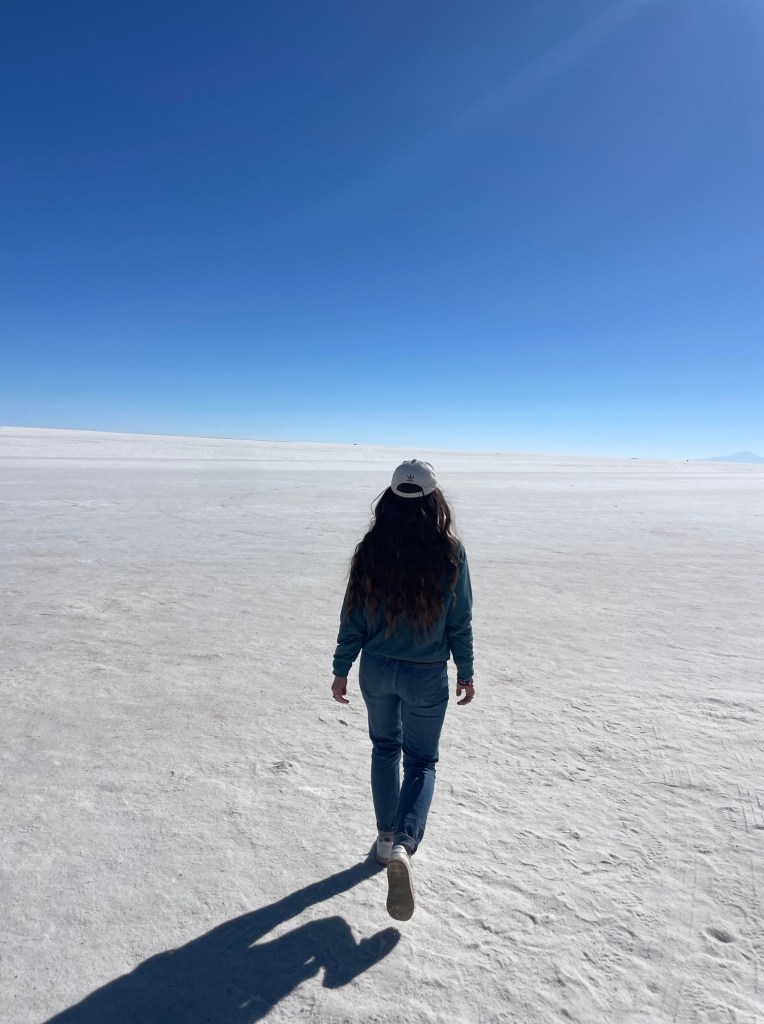
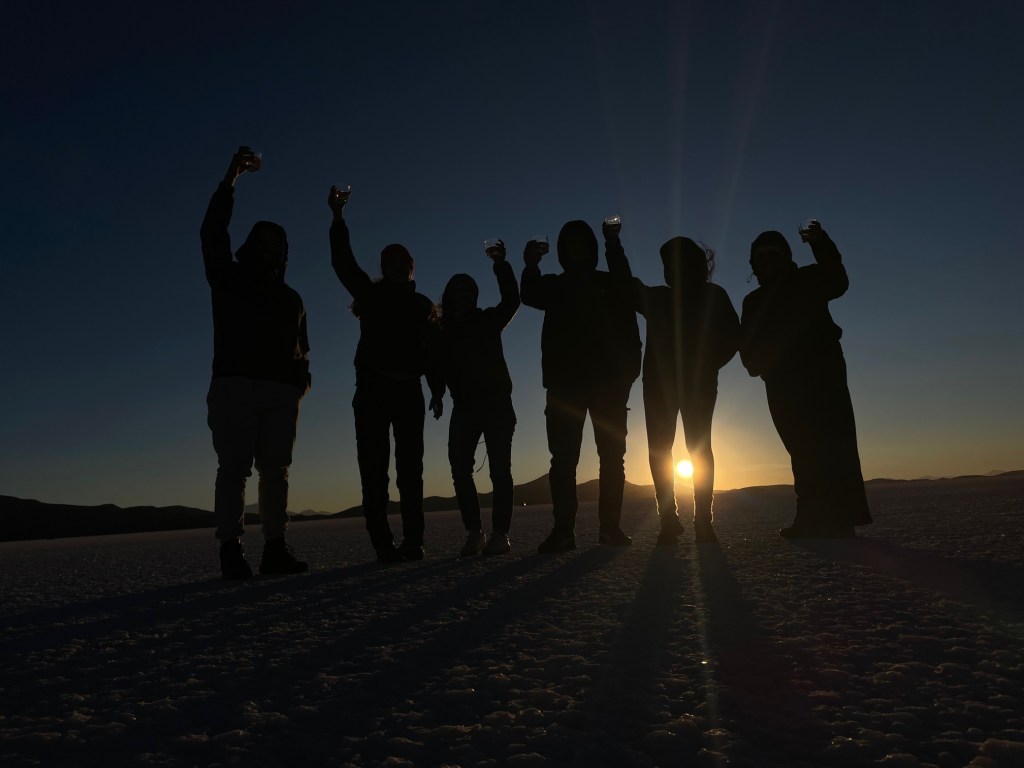
We then went out to the salt flats and took approximately one million photos. Our guide even facilitated (read: forced) various photoshoots and poses to demonstrate the optical illusions caused by endless miles of salt. We ended the day with a glass of wine at sunset and it was absolutely spectacular. That night we spent the night in a “salt hotel” which is exactly what it sounds like. The floor was loose salt and the walls were salt bricks. There must have been some sort of insulating properties because it was actually quite comfortable and protected us against the bitter cold outside.
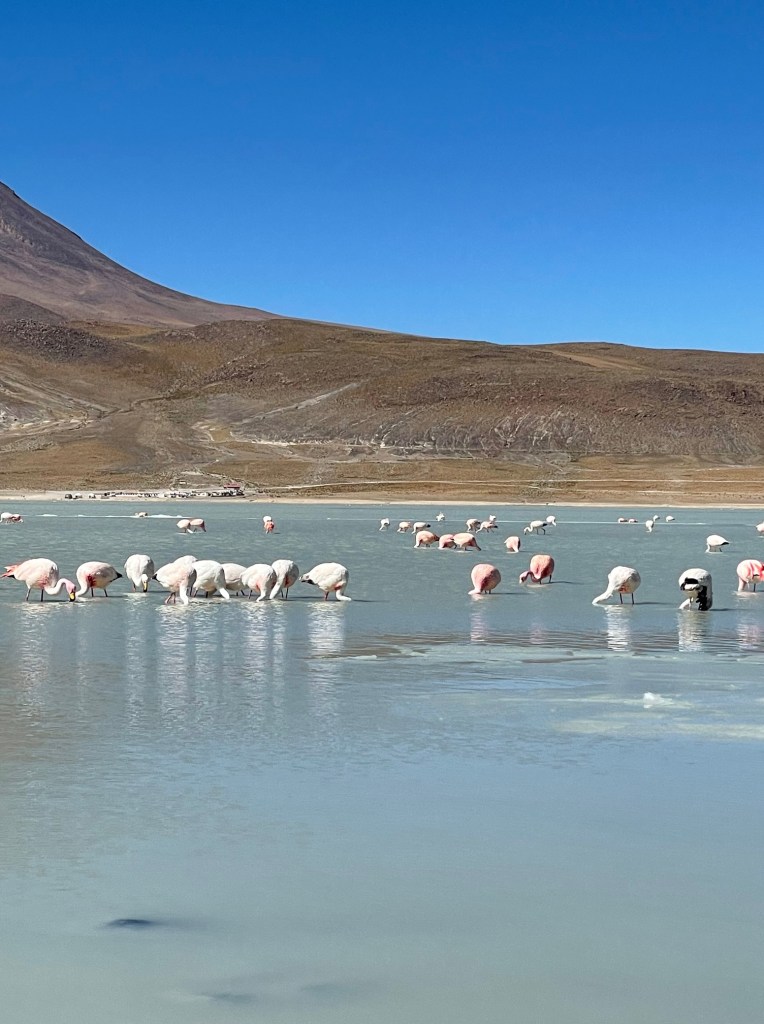
The next day we visited the train line that was built to run from Chile as well as the lagoons full of flamingos. I had always incorrectly assumed that flamingos were tropical birds but in fact three of the world’s six flamingo species reside in Bolivia and visit the lagoons due to the abundance of plankton. Some of the lagoons even had ice forming on the tops! I also learned that flamingos can live 30+ years in the wild and up to 70 years in captivity! We also saw llamas and a petrified tree and ended the day at a very bare bones hotel within the Reserva Nacional de Fauna Andina Eduardo Avaroa.
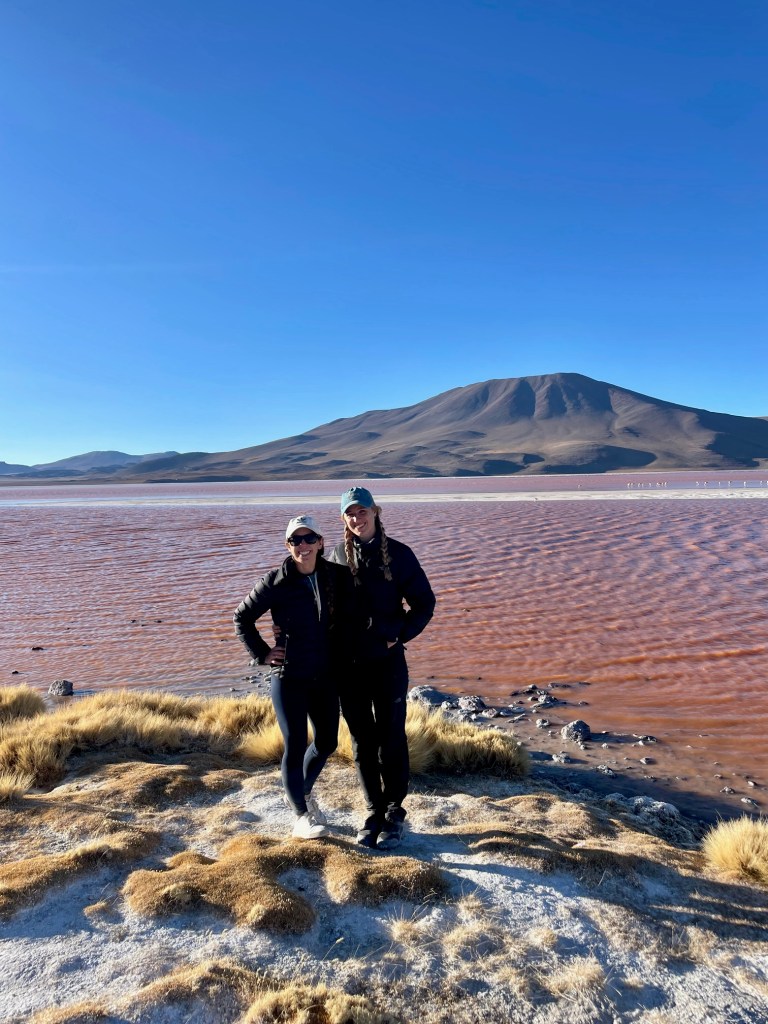
The following day we woke up at the crack of dawn (4:45 am) and headed out to see some volcanic geysers and hot springs we were able to swim in. From there I broke off from the group because I was scheduled to end the tour in Chile as we were so close, while the rest of the group was going to head back to La Paz. I think I got really lucky because I had an awesome crew of Brazilians, Italians and a New Zealander and we really made the most of the three days we had together.


The border crossing was crazy because we drove up to a small building in the middle of the desert and I got a passport stamp and a small * very important * receipt that showed entry into Chile. I switched to a larger bus and was driven closer to the town of Atacama. Once we were definitively in Chile there was a checkpoint where luggage went through a metal detector. Afterwards we were reloaded on the bus and dropped in downtown Atacama which is a tiny town but central hub to tourism for the Atacama Desert.
 Backpack Mack
Leave a comment